How often do we get frustrated with life, believing that if something outside of ourselves changed, then we’d be happier? What if the point is to find our inner anchor alongside life’s ups and downs?
“Once we’re done with tutoring, we’re going to head home for lunch, OK?” I say this to my tween as we are driving to Mathnasium, the math tutoring school. I am trying to preempt an argument about getting takeout ahead of time. He was given it as a reward after the first few sessions, now I am newly weaning him from this. He is surprisingly agreeable.
That quickly turns.
“Ok, fine. And why do I have to do tutoring at all? It’s almost the end of the school year anyhow?” He says this in an agitated, disagreeable tone. The fight I thought we were going to have about lunch has shifted to the core issue of math tutoring. Again.
There goes our pleasant drive.
My body knows a fight is coming before it’s greeted by one. Especially with this child. As he talks, my body begins tensing and my heart rate slightly upticks. Luckily, I notice what’s happening. I intentionally keep my hands steady on the wheel and breathe, watching the traffic ahead rather than get caught up in responding. I hope this would end the discussion. But, it doesn’t.
He prods, “Mom? Why? Answer meeeeee?”
The drawing out of the last letter sets me off.
When will he get over this?
Still, I say nothing.
My stretched silence and focus on driving has allowed him to connect the dots and mount a stronger argument. He turns his face towards me and asks me,“Wait! Mom, am I doing math tutoring this summer, TOO?”
My jaw clenches. My grip tightens on the wheel.
Seriously? Why are we doing this again? Why can’t he get over it?
I drive a little faster, knowing a fight will erupt in the car by my affirming summer math classes. I turn on my signal to exit off the freeway, hoping we arrive faster than this discussion will escalate. I made the left into the shopping complex and just hum the words “uh-huh.”
I was focused on externally showing calmness though my interior state was the opposite.
Really? MOM?! MOMMMM?!!! He screams out.
I am fully triggered. Though I kept driving and kept quiet, underneath, my blood was boiling. My zen mom mode has relapsed into because-I-said-so mode. I finally speak. It was terse and direct. I shut down the conversation and urge him to get on board with tutoring and to hop out of the car, so as to not be late. He did exit the car, but not without some choice backtalk.
The audacity of this kid!
For the next 20 minutes, I spent my drive home justifying all the ways my child was wrong and out of line. I was his parent, after all. I knew what’s best for him AND had told him this plan a million times.
I’m so mad at him!
Even while home, I couldn’t mentally stop replaying how frustrated I was by my son’s resistance, wondering why he couldn’t get over it?
And as I got back in the car for his pick up, it hit me. He was over it. I wasn’t. The issue was not really him, it was ME. More than likely, he had moved on from the issue and was immersed in doing his math and moving on with his day. I, on the other hand, was still agitated.
Driving back to the scene, I reflected more. I saw that the issue wasn’t just that my son was feeling resistance about summer math. (Though that is plenty annoying.) The core problem was my resistance to his reaction. I did not like the way he was reacting and tried everything to get it to stop. When I couldn’t, I got triggered. My being displeased that my son wasn’t giving me what I wanted in that moment was actually the heart of the issue, not my son nor math tutoring.
I was wanting him to change his reaction, so that I could have the kind of drive I wanted – peaceful, agreeable and fun. I didn’t get that. And I tried everything I could, including remaining silent, to reach equilibrium again. But, it never arrived. And I blamed it on him, when the issue was really me.
How often does this happen to us every day? We try to correct and set the world straight – so that it acts the way we want to ensure we feel the way we want. That’s the heart of control. How much of our motivations as Type-A people are to get what we want, so we can feel good, happy and at peace? When we don’t, we hate how it makes us feel? So we try again to align the world in such a way that we become pleased.
This is at the heart of our suffering, our preferences for certain outcomes and behaviors. For me, I wanted my son to stop. When he didn’t, I became unhappy. Rather than focus on myself, I focused on maneuvering him or around him to get what I want another way. Either way, the heart of the issue was ME not getting what I wanted in that moment.
Michael Singer speaks about this in his podcast, as well:
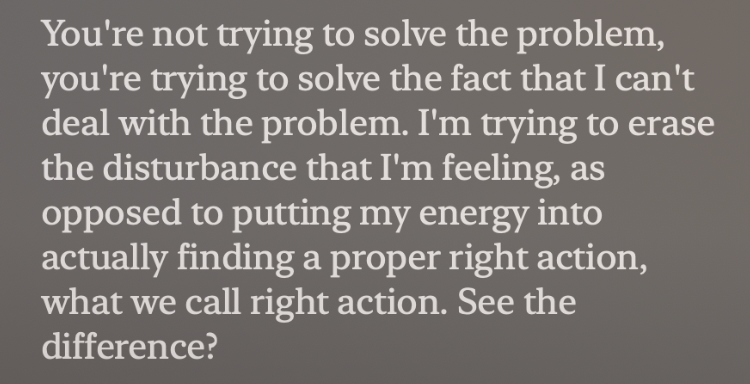
The proper right action he refers to, in my opinion, is going within. It is accepting. It is connecting with our hearts to explore what it desires in that moment that is making our minds spin out of control. Since then, I have learned a technique that helps tap into your heart center to explore your feelings and mind more in such moments: Simply put your two hands on your heart. Then, close your eyes. Breathe into your heart space and ask it what it is feeling. Then mentally repeat it back to yourself in this format, “this is what it feels like to feel XYZ.”
Had I done this heart exploration exercise, I would have noticed that my heart was wanting a peaceful car ride and to not fight about tutoring. That I wanted him to accept it. So, in my exercise, I would have silently mirrored to myself, with my hands on my heart: “This is what it feels like to not get what I want. This is what it feels like to feel not heard and frustrated.”
Knowing this, I could have then focused my efforts on tapping into those feelings and not focusing as much my son and what my mind was telling me about him.
This is the practice. The work. Yes, we should meditate. The quiet of meditation gives us insight into something deeper inside ourselves, making that easier to access in the turbulence of life. Riding the waves of life’s frustrations with evenness is what the work allows us to experience more and more.